
If your hair has formed a compact mass that will not separate easily with your fingers, stop pulling and contact a salon experienced in difficult detangling. Stop if handling your hair causes pain, pulls on your scalp or breaks strands. You do not need to force your way through it at the expense of your hair or comfort.
Is it an ordinary knot or a compact mass?
An ordinary knot usually affects one section. You can see where it starts and ends, and the hair around it still moves freely. A compact mass feels more like a block: several sections are tangled together, the edges are hard to trace and moving one part pulls on the rest.
A small tangle at the ends is not the same as a dense clump at the nape, close to the roots. Size alone will not tell you how difficult it is to handle. A small, tightly packed block can be harder to work with than a larger, looser tangle.
| What you notice | What to do |
|---|---|
| One clear section, soft edges and no pain | You may be able to try a little gentle handling. |
| A dense block with no easy separation between sections | Do not brush through it; ask a salon to assess it. |
| The roots move or your scalp feels pulled | Stop pulling immediately. |
| A wound, oozing or persistent pain | Get medical advice before handling the hair again. |
When to put the brush down
Pain and pulling at the roots
Detangling should not mean putting up with pain. If your head follows the brush, your skin lifts with the movement or you have to hold the roots firmly to keep going, you are pulling too hard.
The American Academy of Dermatology states that a painful hairstyle is too tight. Pain during detangling is a reason to stop, too. You do not have to push through it.
Breaking strands or getting nowhere
Stop if you see strands breaking under your fingers or find yourself using more force with each movement. Going over the same spot will not help if the brush stays stuck. A few hairs coming out of the mass do not necessarily mean you are making progress. Look for sections that separate without pulling on the scalp.
What you can safely check at home
Only handle sections you can reach easily and that still feel flexible. Hold the length in your hand and gently check whether the outer sections come apart with your fingers. If they resist, leave the centre of the block alone. Switching to a finer comb will not make this safer.
Do not brush from the roots through the mass or use a pointed object to pry it open. Avoid rubbing it with a towel or squeezing it with a hair tie. Do not cut where you cannot see clearly, especially near the scalp.
Oil baths, acidic recipes and heated tools are not a way to force the mass apart. Before washing your hair to tackle it, ask the salon how they would like you to arrive. They may want to see it as it is. While you wait, keep anything from pulling on the area.
Booking an appointment without feeling you have to explain yourself
When you call, describe “a compact mass that is difficult to separate” rather than “a few knots”. Tell the salon where it is, how close it sits to the roots and whether it hurts. Let them know what you have already tried, along with any colour treatment, bleach or extensions.
An overall photo and a close-up can help, but do not pull the hair apart to show the inside. Ask whether the salon handles this kind of detangling and will assess your hair before starting. If you want to keep as much length as possible, say so. You can also ask them to avoid painful handling and speak to you before making any cuts. No one can guarantee the result from a photo or phone call.
Significant matting can happen during illness, through a difficult period or after a complicated hair-care routine. You do not owe anyone a justification. If you have a wound, painful scabs or pain even when you are resting, get medical advice rather than relying on a hair appointment alone.
A hair-care product cannot undo a compact mass
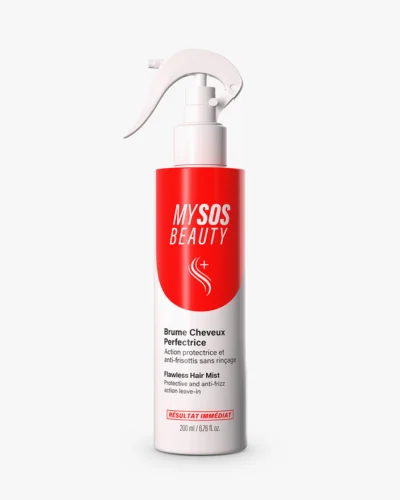
The manufacturer describes Perfecting Hair Mist as protecting against heat, taming frizz and adding shine. It will not open a matted block. The instructions involve blow-drying with warm air while brushing gently, so leave that routine aside if the mass still resists.
After the matting has been dealt with, you may want to revisit your usual care routine. Our articles cover the impact of hair colouring, choosing hair oils and the role of pH in hair care. They can help with ongoing care, but they are not instructions for separating a compact mass.
FAQ
Can I keep going if it does not hurt?
No pain does not automatically mean it is safe to continue. If the sections will not separate easily or you need to force them apart, stop.
Will it have to be cut?
Not necessarily. The salon needs to see your hair in person to discuss the options. Ask them to explain any proposed cutting before they begin.
How can I tie my hair while I wait?
If you need to, gather only the loose sections, keeping them relaxed so they do not pull on the block. Take the tie out if it causes tension or discomfort.


Comments (0)