
A hair care product can leave your hair softer, easier to detangle and less likely to break without restoring it to its original condition. When you see a “repair” claim, look at what is actually changing: the way your hair looks, how easily the strands move against one another or how well they resist breakage. A bond-repair claim should explain its mechanism and show results for the finished product. These benefits can overlap, but they are not the same thing.
What does “repair” mean in a hair care product?
The visible part of the hair is not living tissue, so it cannot heal itself. A product can soften or disguise signs of damage, but a damaged length does not become identical to intact hair.
That is why “repair” can describe several different effects. A product may coat the fibre, help strands glide more smoothly or claim to act on specific internal interactions. Before buying it, turn the claim into a result you can actually assess.
| Claim on the packaging | What to look for | What it does not prove on its own |
|---|---|---|
| Softness, shine, smoother hair | An improvement in feel or appearance | Increased strength |
| Easier detangling, less friction | Better glide as the comb passes through | Internal reconstruction |
| Less breakage, strengthened fibre | An appropriate breakage or strength test | A return to intact fibre |
| Bond repair | The bonds targeted, the mechanism and the measurements | Restoration of every damaged structure |
Surface effects are useful, not secondary
When your lengths catch as you brush, better glide can make a real difference. Less friction may reduce the mechanical stress involved in detangling. The review Hair Cosmetics: An Overview describes the lubricating role of conditioning products on the cuticle.
If your comb moves more easily through your ends after you use a product, that is a detangling benefit. If your hair reflects light more evenly, you are seeing more shine. Neither result shows that the hair’s internal bonds have been repaired.
If you want to explore this side of hair care, our guide to hair oils by hair type can help you narrow down your choice. Just keep the distinction in mind: a better feel is not a measurement of strength.
“Bond repair”: what questions should you ask?
Which bonds are we talking about?
Hair gets its structure from several types of bonds and interactions. They do not all play the same role or respond to the same conditions. Hydrogen bonds, for example, contribute to temporary styling. Water and changes in humidity can affect how a style holds, as explained in Clarence R. Robbins’ reference book.
A style that changes in humid conditions does not, by itself, point to damage comparable to bleaching. An anti-humidity formula is not automatically a bond-repair treatment.
Does the result apply to the product you are buying?
A keratin diagram or a study of one ingredient may suggest how an action could work. To assess the product itself, look for testing on the finished formula, used according to its instructions.
- What was measured: shine, ease of combing, breakage or tensile strength?
- Which hair was tested: was its condition similar to yours, especially if your hair has been bleached?
- What was the comparator: untreated hair, a reference product or another protocol?
- What were the conditions: did application, drying and washing match the intended use?
A before-and-after photo shows a change in appearance. A satisfaction survey tells you how the product feels to use. A mechanical test looks at strength. Each result answers a different question.
Choose according to your problem, not the strongest wording
Is your hair dull and difficult to style? Focus on claims related to softness, shine or detangling. Is it breaking after chemical treatments? Look for results relating to breakage, while also reducing repeated sources of damage. Our article on the impact of hair colouring on your hair helps put this situation into context.
pH can also influence how a formula behaves, but it is not, on its own, proof of repair. To explore this factor, read our explanation of the role of pH in hair care.
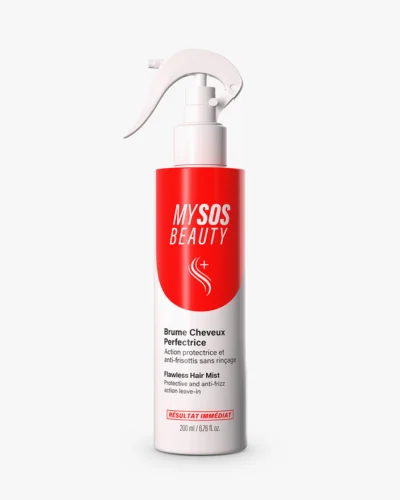
Example: understanding Perfecting Hair Mist
According to the manufacturer, Perfecting Hair Mist coats the fibre with a protective veil, helps control frizz, protects the hair from humidity and shields it from heat. It also aims to create a smoother, shinier appearance. This positioning does not claim to repair bonds.
How you use it matters too. Spray generously onto washed, towel-dried hair, section by section, then distribute. Blow-dry on a warm setting while brushing gently. This activation is essential. For the best result, the manufacturer asks you not to use another styling product before blow-drying. Space out applications according to your preferences and hair type.
FAQ: how to interpret a repair claim
Can a hair care product get rid of split ends?
It can temporarily improve their appearance, but it cannot permanently fuse a split end back together. Cutting removes the split section.
Does less breakage necessarily mean that bonds have been repaired?
No. Better lubrication may also help limit breakage during detangling. The result alone does not show which mechanism is responsible.
How can you assess your product at home?
Compare it using similar styling movements: ease of detangling, feel, frizz and the amount of broken hair you notice. These observations can help you decide whether the product works for you, but they do not demonstrate a molecular change.


Comments (0)