

If your face burns after cleansing or your usual moisturiser stings, hold off on azelaic acid for now. Stick with the products you already tolerate. Once your routine feels comfortable, add azelaic acid as the only new product, so you can tell how your skin responds. It has specific uses, and more redness is not proof that it is working.
Redness does not always have the same cause
Red cheeks after a hot shower, an itchy patch, or persistent redness with spots can have different causes and may need different approaches. DermNet explains that “sensitive skin” means having a reduced tolerance to cosmetics; it is not a diagnosis. Irritation, contact allergy and rosacea can all cause these sensations (DermNet: Sensitive skin).
Azelaic acid is used, among other things, to treat acne and papulopustular rosacea, a form of rosacea with spot-like lesions. A cosmetic serum will not necessarily clear every kind of redness or visible small blood vessel. DermNet’s information on azelaic acid concerns specific uses and formulations.
If your redness keeps coming back or persists without an obvious trigger, speak to a healthcare professional before adding another active ingredient. Our article on the signs of sensitised skin may help you describe the discomfort during your consultation. It does not replace medical advice.
Medicine or cosmetic: follow the instructions for your product
Products labelled “azelaic acid” are not automatically interchangeable. DermNet describes medicinal preparations at 15% and 20%, among others. Their directions may not apply to a cosmetic, which can have a different formula and concentration.
Before you start, check the directions for use, how much to apply, how often to use it and which areas to avoid. Look at the other ingredients and the concentration, if it is provided. The INCI list may include azelaic acid without stating its percentage. A lightweight texture or a “sensitive skin” claim does not guarantee that the product will suit you.
If you have been prescribed a medicine, follow your healthcare professional’s advice and the product leaflet. If you are unsure whether you will tolerate it, ask how to introduce it before changing the way you apply it.
For a cosmetic, follow the manufacturer’s directions. A schedule that works for another formula may not be right for yours.
Start when your usual products are not irritating your skin
Before applying azelaic acid for the first time, notice how your skin feels after using your usual products. If your cleanser leaves a burning sensation, your moisturiser has started to sting, or some areas are peeling or raw, wait. Adding an active ingredient at that point would also make it harder to work out which product is causing the problem.
Keep using a gentle cleanser, a moisturiser you already tolerate well and suitable sun protection. These are among DermNet’s recommendations for sensitive skin. Our guide to the skin barrier and blemishes may help you look at your routine, but redness alone cannot diagnose a “damaged” skin barrier.
Do not make your first application just before an event. Pick a time when you can keep an eye on your skin, and use the stated amount, including on a redder cheek.
For some azelaic acid creams, DermNet describes gradually increasing applications according to tolerance. If your cosmetic’s instructions allow you to begin with applications spaced out over time, follow that pace while you see how your skin responds.
Space out exfoliants and other potentially irritating products
When you first try azelaic acid, avoid applying it alongside retinol, an AHA or BHA exfoliant, or benzoyl peroxide. With non-prescription cosmetics, you can use them on different days or temporarily put aside products that already irritate your skin. If they are part of a treatment, ask your doctor or pharmacist how to organise them.
Using products at different times can make it easier to identify which one is causing a reaction. That does not mean all these combinations are chemically incompatible. DermNet describes the addition of several irritating factors as one possible cause of irritation.
There is also no need to use a grain scrub or cleansing brush to “prepare” your skin.
A Centella mask is optional and should be tried separately
If you are considering a product containing Centella Asiatica, wait until you have assessed your tolerance to azelaic acid before trying that product too. An ingredient described as soothing does not guarantee that the full formula will suit your face.
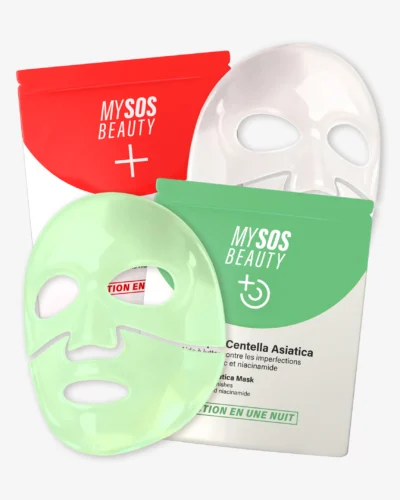
The Pack de 4 Masques Centella Asiatica does not contain azelaic acid in its published ingredients. You do not need it to introduce azelaic acid, and it is not a treatment for redness. Its formula includes fragrance.
Do not add it to make up for a reaction to another product. If you decide to try it later, follow the instructions in its official product directions:
“At night (recommended): apply the mask at the end of your evening skincare routine and leave it on overnight. In the morning, when it has become completely transparent, remove it gently.”
“During the day: apply it at any time and leave it on for at least 4 hours, until it is completely transparent. For best results, use this mask once a week.”
“Clean your face thoroughly before applying the mask. Gently apply the hydrogel mask, starting with the lower part of the face and then moving to the upper part. Adjust each section to the shape of your face. Depending on its size, the two parts of the mask may overlap slightly.”
“Remove the mask gently and go straight on to your usual skincare or makeup. There is no need to rinse or cleanse your face.”
If you react, take a break and seek advice
Make a note of the product you applied and what you notice: stinging, heat, itching, flaking or more pronounced redness. A photo taken in the same conditions may help you describe changes over time, but it cannot be used to make a diagnosis.
Do not push through burning in the hope of “getting your skin used to it”. DermNet states that azelaic acid can irritate very sensitive or eczema-prone skin. If you develop severe redness, flaking, itching or burning, the source recommends stopping application and seeking medical advice (azelaic acid side effects).
Discomfort that returns every time you apply the product is also a reason to take a break and seek professional advice, even if it is not severe. The complete formula may be responsible, rather than the active ingredient alone.
DermNet does not describe azelaic acid as causing photosensitivity. Even so, keep using sun protection, which is among the measures recommended for sensitive skin. Our article on daily sun protection covers some practical steps.
When you speak to your pharmacist, bring the exact product name and a list of your current products. If you have had a reaction, explain where and when it appeared. Those details will be more useful than simply saying, “My skin is sensitive.”
 -44%LIMITED OFFER

Comments (0)