

If your hair tangles often, start by noticing where the knots come back and what happened before they appeared. Ends that catch even after washing may point to worn hair. Knots at the nape after several hours in a scarf are more likely to come from friction. If your lengths feel weighed down after several treatments, product build-up may be involved. Changing your detangler will not necessarily fix the reason the tangling keeps returning.
Look for the pattern, not just the knot
Make a note on your phone of the area affected: the ends, nape, underneath the lengths or the whole head. Add when it happens: when you wake up, after washing, travelling, exercising or applying a treatment.
Notice how the hair around the knot feels as well. Is it rough, sticky, dull, swollen or simply tangled? These details cannot provide a diagnosis, but they can help you decide what to look into first.
For example, “knots underneath my hair, on the shoulder-strap side, after travelling” gives you more to work with than “my hair is impossible”. By contrast, if “the same ends catch even when I have not been out”, clothing is less likely to be the cause.
Use concrete clues to narrow down the cause
| What you observe | Possibility to explore | Targeted action |
|---|---|---|
| Knots concentrated at the ends, with visible split ends | Worn ends | Ask your hairdresser to assess the ends and consider a suitable trim |
| The nape or underneath of the lengths tangles after prolonged contact | Repeated friction | Reduce the contact you have identified, then compare |
| Lengths feel weighed down after layering several treatments | Product build-up | Simplify your routine and check that products are rinsed properly |
| Hair feels swollen and tangles mainly in humid weather | Humidity combined with other factors | Distinguish frizz from genuine knots |
Worn ends: notice where the hair keeps catching
The ends are the oldest part of the hair. They have been through more washing, contact and sometimes chemical treatments than the rest. As the surface becomes damaged, the fibres are more likely to catch on one another. Split ends and visible breakage make this explanation more likely.
If the knots stay in the same area despite a suitable routine, ask your hairdresser to assess your ends. A treatment may make them feel better, but it cannot permanently remove a split end. If the problem began after bleaching or colouring, our article on the impact of hair colouring can help you understand this factor.
Product build-up: look at the layers rather than blaming one ingredient
Think about changes that started after adding an oil, a leave-in treatment or several styling products. A coated feeling, strands that clump together and a loss of lightness may mean that your routine has become too heavy.
Go back to a simpler routine, follow the washing instructions and rinse products thoroughly when they are meant to be rinsed out. Do not automatically blame silicones: the review Hair Cosmetics: An Overview explains that their deposition and removal vary according to their nature.
If you use an oil, our hair oil guide may help you choose one. The point is to see whether adding it coincides with the knots returning, not to apply more of it.
Repeated contact: find the friction point
At the nape, check collars, scarves and hoods. On one side, consider a shoulder strap or any area where your hair may get trapped. If the knots appear when you wake up, see whether they mainly affect the lengths that touch your pillow.
Try one change related to the suspected contact: keep your hair away from your collar or secure it loosely so it cannot get caught. If that area tangles less, you have a useful lead without changing your whole routine.
Build a routine around what you notice
Change one thing at a time. Otherwise, you will not know what made a difference. Keep your notes and compare similar situations: the same clothing, the same setting when going out or the same washing routine. Focus on reducing knots in the area you are monitoring, rather than simply making your hair shinier.
Avoid homemade mixtures intended to change the acidity of your treatments. To understand this factor, read our article on the role of pH in hair care.
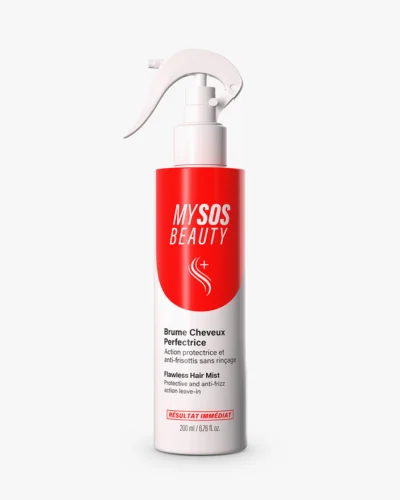
Where does Perfecting Hair Mist fit in?
Perfecting Hair Mist may fit into your routine if your observations mainly point to frizz and hair that expands in humid weather. According to the manufacturer, it helps control frizz, protect hair from the effects of humidity and protect it from heat. It is not a treatment for recurring knots or split ends.
Its directions recommend washing your hair, towel-drying it and then spraying generously onto damp hair, section by section. Distribute it evenly with your fingers or a detangling brush. Blow-dry with warm air while brushing gently: this activation step is essential. For the best result, do not apply another styling product before drying. Space out applications according to your preferences and your hair type.
FAQ: understanding recurring hair knots
Can soft hair still become tangled?
Yes. Hair can feel soft and still become tangled when the lengths cross through contact. Pay attention to where and when the tangling occurs.
Do you always need to cut your hair?
No. A trim is mainly relevant when the ends are genuinely damaged. It will not resolve repeated contact at the nape or a routine that has become too heavy.
When should you ask a professional for advice?
If the tangling suddenly becomes severe, forms a mass that is difficult to separate or comes with significant breakage, ask a hairdresser for advice. Unusual hair loss or a painful scalp calls for medical advice.



Comments (0)