

No cosmetic treatment can permanently repair a split end. It can soften the lengths, make detangling easier and disguise some irregularities. But once a hair has genuinely split, cutting away the damaged section is the only way to remove it. Start by learning to tell a dry tip from a split end, then protect as much of the remaining length as you can.
How can you recognise a true split end?
Examine your dry hair in natural light, before applying anything that could smooth its appearance. Isolate a small section and hold the ends against a contrasting background: light for dark hair and dark for light hair. Check several areas, especially the nape, the hair around your face and the lengths that rub against your clothing.
A split end is a visible separation in the hair fibre. Roughness or frizz on its own does not mean that a hair is split.
| What you observe | What it means | The useful decision |
|---|---|---|
| A Y-shaped end | The tip divides into branches: this is a split end. | Remove the split section. |
| A branched tip, like a small paintbrush | The fibre has several separations. | Ask your hairdresser to assess how much needs to be cut, rather than removing only the very end. |
| An opening higher up the hair | The split is not limited to the tip. | Cut above the visible opening. |
| A dry but intact tip | It may feel rough without being split. | Improve your care routine and check its condition again. |
| A white spot or a clean break | It is not necessarily a split end; the fibre may be weakened. | Monitor breakage and ask for advice if it is significant. |
Why can a treatment seem to repair split ends?
The visible part of the hair is a keratinised fibre. It does not heal like skin. Once it splits, water, oil or a conditioning film cannot restore its original structure.
A treatment can still lubricate the surface and reduce friction during detangling. The ends catch less and look more even. The review Hair Cosmetics: An Overview describes how conditioners lubricate the cuticle and help with detangling.
Improved texture does not mean that the split has disappeared. Your ends may look flawless after styling, but if the branches are still visible when you isolate them, the damage remains. Our guide to hair oils by hair type can help you choose suitable care, without expecting an oil to mend a split end.
When should you cut, and how much should you remove?
A few isolated split ends
If the splits are rare and limited to the very ends, a targeted trim can preserve most of your length. Ask your hairdresser to identify where each split begins. Cutting only the tip of one branch leaves part of the split hair in place.
Heavily branched ends or splits higher up
If your ends tangle easily, have numerous branches or look noticeably thinner, simply refreshing the edge may not be enough. Show the affected areas to your hairdresser and agree on how much length to remove. There is no universal amount: the cut needs to go beyond the part that is actually damaged.
Avoid pulling off the branches with your fingers or separating them to “clean up” the end. This can extend the tear. If you trim your hair yourself, use sharp hairdressing scissors rather than household scissors.
After the cut: check and prevent
Once your hair is dry, examine the affected areas again. Clean-cut ends indicate that the splits you noticed have been removed. If some remain higher up, point them out to your hairdresser. An even cut will not necessarily remove every damaged section.
- Detangle without pulling: start at the ends, then work upwards gradually while supporting the section.
- Blot without rubbing: press the lengths in a towel instead of rubbing them.
- Limit tension: avoid ties that pull or catch in the same place repeatedly.
- Reduce repeated heat exposure on fragile ends.
If you colour your hair, check areas that have already been weakened before booking another service. Our advice on the impact of hair colouring covers another part of this prevention. For more on the role of formulas in caring for the hair surface, read our article on pH and hair care.
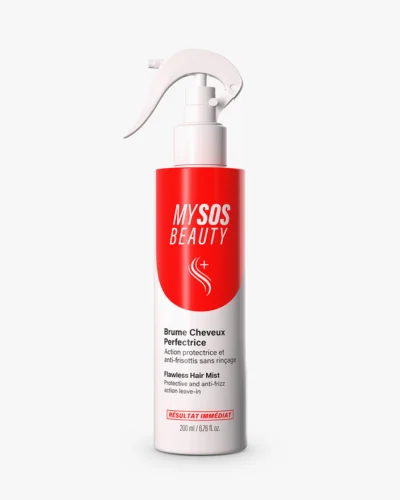
What is the role of Perfecting Hair Mist?
Perfecting Hair Mist is designed for styling, not for removing split ends. According to the manufacturer, it helps protect against heat, control frizz and add shine.
Apply it generously to washed, towel-dried, damp hair, section by section. Distribute it with your fingers or a detangling brush, then blow-dry with warm air while brushing gently. This activation is essential. For the best result, the manufacturer advises not applying another styling product before blow-drying. Space out applications according to your preferences and your hair type.
FAQ: the questions that help you decide
Do split ends stop hair from growing?
No. Growth happens at the roots. However, breakage along the lengths can make it seem as though your hair is no longer gaining length.
Do you need to cut ends that are simply dry?
Not automatically. If they remain intact, first improve detangling and limit damaging stress. A visible split, on the other hand, justifies cutting away the affected section.
Why are there still split ends after a haircut?
Some may be on shorter hairs or may begin above the cut line. Have these areas examined rather than adding more treatments in an attempt to make them disappear.


Comments (0)