

If your hair lifts after brushing, follows your comb or sticks to your face, static electricity may be the cause. If your strands stay irregular, wavy or puffy without being drawn towards anything, frizz is more likely. Before reaching for a smoothing product, think about what happened just beforehand. Changing the source of the friction may help more than adding another treatment.
How to recognise static before changing your routine
One stray hair does not tell you much. Pay attention to how your hair moves and what happened just before. These clues are often more useful than a photo.
| What you notice | What it may indicate | First thing to check |
|---|---|---|
| Your hair separates after you run a comb through it and seems to follow the comb. | An electrostatic charge. | The comb and repeated passes. |
| Strands stick to your cheeks after you take off a jumper. | Electrification caused by contact with fabric. | The garment and the way you remove it. |
| Strands remain bent or irregular without following nearby objects. | Frizz or a change in styling. | The condition of the lengths and how they were styled. |
| Short hairs always stick out in the same places. | Possible regrowth or breakage. | Their length and appearance, not just whether they lift. |
These effects can overlap. Hair may already be frizzy, then pick up a static charge while you brush it. To understand how water can change the shape of your hair, read our article on frizz and humidity.
What causes static electricity in hair?
Contact and separation between materials
When your hair touches a brush, hat or garment and then separates from it, electrical charges can be transferred. Friction increases the contact between the materials. Strands carrying charges of the same sign repel one another, so they spread apart and lift. Hair can also be attracted to a nearby object or cling to your face.
A familiar example is pulling a jumper over your head when your hair looked fine beforehand, only to find the lengths spread out afterwards. In that case, contact with the fabric is the likely trigger, not necessarily a lack of nourishment.
The combination of materials matters
Some plastic accessories and synthetic fabrics can encourage electrification in certain conditions. Still, “natural” does not automatically mean “anti-static”. The result depends on the materials touching each other, their surfaces and the condition of your hair. A wooden brush is not a guarantee, especially if its bristles are made from another material.
Dry air also allows charges to remain for longer. This is different from frizz: static is an electrical charge, while frizz involves a change in the hair’s shape.
Check your accessories and product build-up without stripping your hair
Start with your brush. Trapped hair, dust or styling-product residue can make brushing less smooth. Remove any accumulated hair and clean the accessory according to its care instructions. Then compare it with another comb.
On the lengths, notice whether they feel rough, sticky or coated. Build-up can affect how smoothly a brush moves through the hair, but it does not prove that the hair is statically charged. Avoid responding by switching automatically to harsher washing.
Conditioning agents can make detangling easier and reduce friction. The review Hair Cosmetics: An Overview notes that silicones differ in their deposition, adhesion and removal during washing. Their presence alone is not enough to show that problematic build-up is present.
What to try depending on the trigger
- After brushing: detangle the ends first, then work gradually upwards. Avoid quick, repeated passes to flatten the strands, as they can create more electrification.
- After wearing a hat or jumper: remove it gently and limit friction against the lengths. Compare it with another fabric before changing your entire routine.
- To calm temporary flyaways: gently smooth the affected strands with slightly damp hands. Do not wet the hair if you want to preserve the style.
- If your lengths catch: review your detangling technique and conditioning treatment. The American Academy of Dermatology states that a suitable leave-in conditioner can reduce static. Always follow its instructions.
Do not add an oil automatically. Our guide to hair oils by hair type can help you choose without overloading the lengths. Also avoid trying to “discharge” your hair with a homemade acidic mixture. The pH of hair care products is a separate issue.
Where does Perfecting Hair Mist fit in?
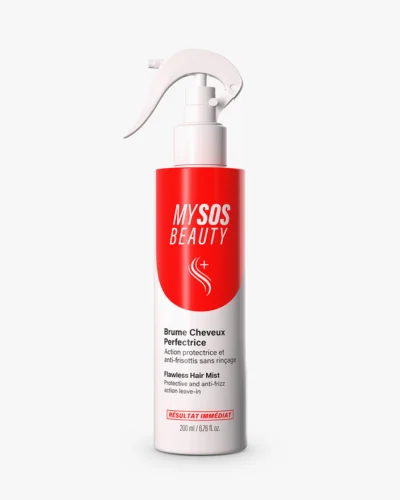
Perfecting Hair Mist targets, according to the manufacturer, frizz, the effects of humidity, shine and heat protection. It is not presented as an anti-static treatment.
If frizz is the issue, apply it generously to washed, towel-dried hair, working strand by strand. Distribute it with your fingers or a detangling brush, then blow-dry on a warm setting while brushing gently. This activation step is essential. For the best result, the manufacturer asks you not to use another styling product before drying.
FAQ
Does static mean that my hair is damaged?
No. Static can appear after simple contact. A rough feel, split ends and breakage are different observations.
Should I straighten strands that lift?
Not to neutralise an electrical charge. First identify the contact that triggered it. A straightener changes the shape of the hair, not the cause of the friction.
How can I tell whether my comb is responsible?
Compare it with another accessory on hair in a similar condition, without changing your products at the same time. If the flyaway effect appears mainly with the same comb, that is a useful clue.


Comments (0)