
If your hair feels stiff, rough or brittle, that does not mean it has received “too much protein”. It is worth checking what has changed, but the feel alone cannot tell you which ingredient is responsible. Start with the products you use, think back to when you first noticed the difference and make small changes to your routine.
Could proteins be involved?
You may have noticed that your hair feels harder, bends less easily, tangles more or breaks. Those changes can be frustrating, but none is specific to proteins or tells you what caused it.
Take a closer look if the stiffness started after you added a product containing proteins. If the same feeling returns whenever you use it and eases when you stop, with the rest of your routine unchanged, that product may not suit your hair. This still does not prove protein overload: there are other ingredients in the formula too.
If you cannot identify any proteins in your products, or your lengths were already difficult to manage before you began using them, there is less reason to suspect proteins.
Check the ingredients, not just the claims
Which names should you look for?
Look at the ingredient lists on your masks, conditioners and leave-in products. Hydrolyzed Keratin, Hydrolyzed Wheat Protein, Hydrolyzed Rice Protein and Hydrolyzed Silk are examples of hydrolysed proteins. “Hydrolyzed” means the proteins have been broken down into smaller fragments.
You may also spot amino acids, which are not equivalent to a whole protein. And a label saying “repairing”, “strengthening” or “for damaged hair” does not tell you whether the product is protein-based.
The label only tells you so much
You cannot work out an ingredient’s exact concentration from its place on the list. The article of the cosmetics regulation covering labelling generally requires ingredients to appear in descending order, with exceptions for low concentrations. An INCI list will not let you calculate a “protein dose”.
Each formula brings together ingredients that do different jobs. Simply finding a protein on the label does not mean the product will leave your hair stiff or be unsuitable for it.
What else has changed?
If your hair feels hard after styling, check your styling products first: the hold they provide may explain that feeling. If you have started a new routine, think through everything you added, rather than focusing only on the mask sold as repairing.
For stiffness after colouring or bleaching, compare the date of the chemical treatment with when you changed your hair care. If your lengths have become harder to manage after repeated blow-dries, look at how much heat you use and how you handle your hair.
Heat and handling can damage the hair fibre and make it fragile, as the American Academy of Dermatology explains. If you noticed the change after a chemical treatment, our article on the impact of hair colouring can help you look into that.
The pH of hair care products is worth considering separately. Seeing Citric Acid on an ingredient list does not tell you the finished product’s pH. Avoid homemade acidic mixtures intended to “correct” protein overload.
Keep your routine simple while you work it out
Put aside the recently added product you suspect and stick with your usual, well-tolerated products, following their rinsing instructions. Resist adding a clarifying shampoo, a new mask and an oil all at once. If your hair feels different afterwards, you will not know which change helped or made things worse.
Make a quick note of what you used, how your hair feels when dry and how easily it detangles. Try to compare styling sessions under similar conditions. If you stop using a protein mask but start using more gel, for instance, any stiffness that remains will not tell you much about the mask.
If your hair feels better without a product, you can leave it out. There is no need to try it again if you disliked the result. Adding oil to “compensate for proteins” will not test whether proteins were the problem. Our hair oil guide can help you choose oils for hair care, but they are not an antidote.
What about a heat-protective mist?
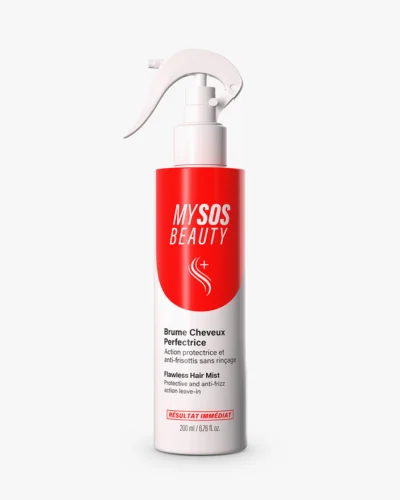
The INCI list for Perfecting Hair Mist contains no identifiable protein. It includes Polysilicone-29, Silicone Quaternium-18 and Glycerin. The manufacturer describes it as a heat-protective product that helps tame frizz and add shine, not a treatment for excess protein.
If it is already part of your routine, follow the instructions: spray generously onto towel-dried, damp hair, distribute evenly, then blow-dry with warm air while brushing gently. Do not apply another styling product before drying. You do not necessarily need to use it after every wash, and there is no reason to add it just to test a theory about proteins.
A few common questions
Can the hair-stretch test give you an answer?
It cannot diagnose excess protein or measure a protein–moisture balance. Avoid pulling on your hair to try to work out what is wrong.
Do you need to stop using every protein-based product?
No. Start with the product you suspect. You do not need to remove a whole family of ingredients: how a product affects your hair depends on its complete formula and how you use it.
When is it time to ask for professional advice?
Seek dermatological advice if significant breakage continues despite a gentler routine, or if you notice unusual hair loss, pain or scalp lesions.


Comments (0)