
Do not pull on a hair to see whether it breaks at a white spot. If you’ve noticed a pale mark, check whether it disappears after your usual wash, stays in the same place or sits at the end of a hair that has already broken. Residue on the surface can look like a weak spot, so the white colour alone cannot tell you what’s going on.
Take a closer look without damaging your hair
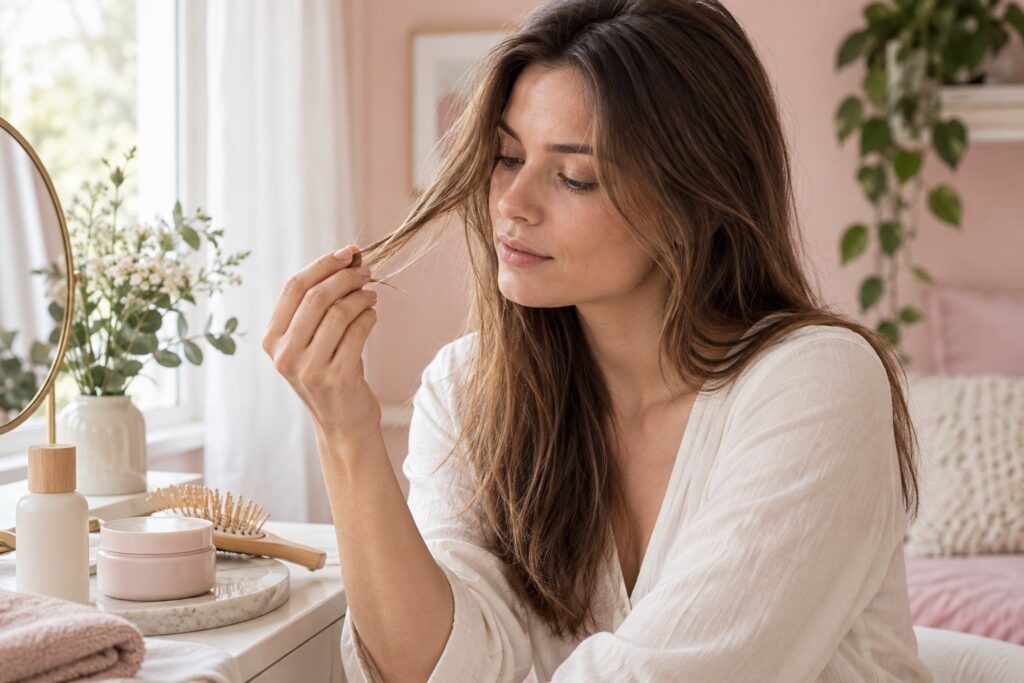
With your hair dry, gently separate a small section without pulling out any hairs. Look at it in soft, diffused light against a contrasting background: dark for light hair, light for dark hair. Skip the flash, which can make a reflection look like a white mark.
Slowly change the angle of the section. A bright area that moves or disappears as the light changes may be a reflection. If it stays put, note where it is: partway down the strand, near the tip or at the end of a short hair.
You may see something like a speck of dust, a small sleeve around the hair or an uneven area within the strand. Describing the shape can help when you ask for advice, but it won’t give you a diagnosis. Resist the urge to scrape the mark with your nail or push it along the hair.
Check again after your usual wash
At your next regular wash, use your shampoo as directed and rinse thoroughly. There’s no need to wash repeatedly to test the mark. Dry your hair without rubbing vigorously, then look at the area in similar lighting before applying a styling product.
| What you notice | What it suggests | What to do next |
|---|---|---|
| The spot disappears after washing. | Surface residue is more likely. | Note which products you used before it appeared. |
| The mark stays in the same place. | It could still be residue clinging to the hair or an irregularity in the strand. | Leave it alone and take a photo if it persists. |
| A hair has broken at that point without deliberate pulling. | This suggests a localised weak spot. | Reduce handling and seek advice if the breakage continues. |
Before deciding a mark has washed away, make sure the hair it was on is still there. If you’ve detangled the section and can no longer find that strand, you cannot tell whether the residue disappeared.
When the mark appears after a powder-based product
Pale particles that appear after dry shampoo and disappear with washing are likely to be residue. The American Academy of Dermatology explains that dry shampoo contains absorbent particles and does not replace washing with water and shampoo. That doesn’t mean every white mark comes from dry shampoo.
When a spot stays on damaged hair
If a mark remains visible on a bleached hair and you find broken pieces while styling, don’t try to snap the strand to check it. Instead, note whether hairs that break on their own seem to break at the marked areas. Our article on how hair colouring affects your hair can help you take past colouring into account when planning your routine.
Be gentle while you work out the cause
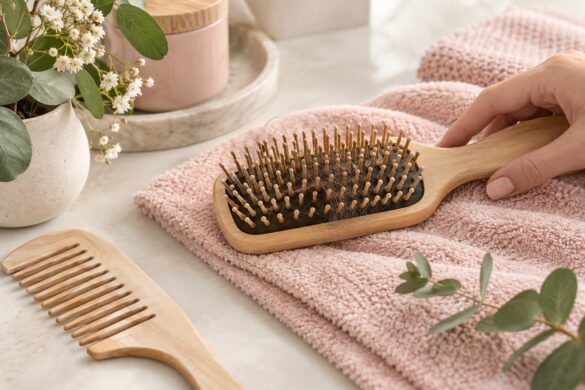
Detangle without tugging, and stop if a section resists. Gently squeeze your hair with a towel rather than rubbing it. If you use heated styling tools, limit repeated passes over the same area. The American Academy of Dermatology notes that damaged hair is fragile and tends to break.
Don’t try to dissolve the spots with vinegar, baking soda or a homemade mixture. Our guide to pH in hair care explains the role of pH in product formulas. Oil won’t help you identify the mark either. If you’re considering it for your routine, the guide to oils for your hair type covers hair care needs, not white spot identification.
What about a heat-protective styling mist?
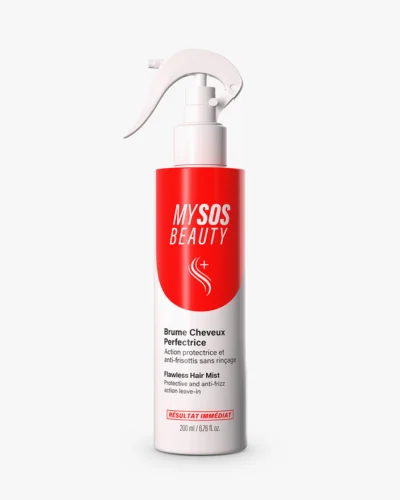
Perfecting Hair Mist is not a treatment for these marks. According to the manufacturer, it helps protect against heat, control frizz and add shine. Spray generously onto freshly washed, towel-dried hair while it is still damp, then distribute evenly. Blow-dry with warm air while brushing gently; heat is needed to activate it. For best results, don’t apply another styling product before drying.
When to ask for professional advice
If the marks persist, become more numerous or appear alongside repeated breakage, show them to a professional. Bring a clear photo and explain what you noticed before and after washing. Note which areas are affected, along with your history of colouring, bleaching and heat styling. A hairdresser can assess the condition of your lengths. For an unexplained change, or one accompanied by scalp symptoms, seek a dermatologist’s advice.
FAQ
Does a white spot always mean the hair will break?
No. You may be seeing residue or a reflection. Whether the mark stays after washing, and whether the hair breaks on its own at that point, tell you more than the colour does.
Should I cut every hair with a white mark?
A white mark alone is not a reason to cut the hair. If you’re also noticing breakage, have your lengths assessed rather than cutting individual hairs at random.
Can a hair care product restore an area that has already broken?
A product can improve how your hair looks and make styling easier, but it cannot reattach a piece that has broken off. Extra shine doesn’t mean the broken area is intact again.


Comments (0)