
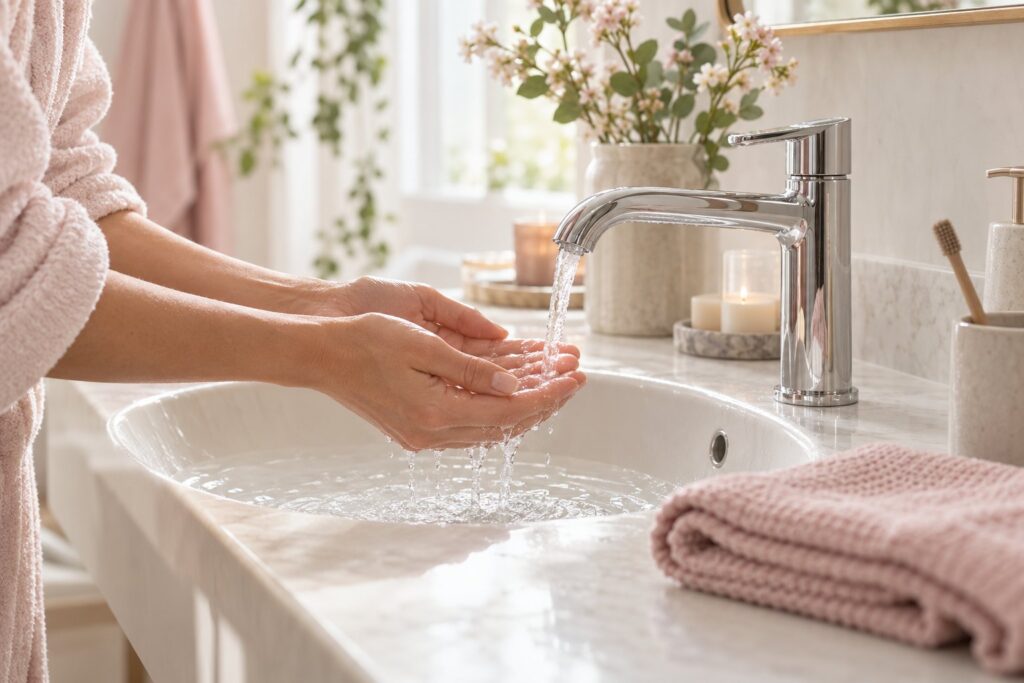
Does your face feel tight after cleansing? Hard water could be part of the reason, but it is not the only possibility. Water that is too hot, a cleanser your skin does not tolerate, frequent washing or rubbing can all leave your skin uncomfortable. Before buying a filter or adding another product, change one thing at a time and see what happens. If your usual moisturiser feels comfortable, keep using it.
What water hardness can tell you
Water hardness mainly reflects the amount of calcium and magnesium in the water. The US Geological Survey explains that these minerals react with soap and can create insoluble deposits. That applies especially to soap. It does not tell you how every facial cleanser will behave.
Limescale on your tap does not prove that hard water is causing your tightness. The reaction between water minerals and soap is well documented. To link your own discomfort to hard water, you need more than a white mark or tight skin after cleansing.
You can check your water hardness on your water bill, through your supplier or local authority, or in regional health agency analysis results where available. Hardness and acidity are different measures. For the latter, read our article to understand your skin’s pH.
Identify the first factor to test
Pay attention to when the discomfort begins: while you massage the cleanser in, after rinsing or once you have dried your face. This gives you a useful starting point for comparing your routine, though it is not a diagnosis.
| What you notice | Factor to examine | First change to make |
|---|---|---|
| Your face feels hot in the shower | Temperature | Rinse with lukewarm water |
| Your cheeks feel tight after using a towel | Rubbing | Pat dry instead of rubbing |
| The discomfort follows one particular cleanser | Tolerance and use | Check the instructions and stop if it irritates |
| Extra cleansing makes the discomfort worse | Frequency | Avoid unnecessary cleansing |
| Comfort varies depending on the location | Water and context | Compare the same routine |
For more on water temperature, see the cleansing mistakes to avoid. The American Academy of Dermatology recommends a gentle cleanser, lukewarm water and your fingers. When you are done, pat your skin dry.
Compare without changing everything at once
Keep the conditions similar
Keep the washing time, amount of cleanser, rinsing and after-cleansing products the same. Use a clean towel made from the same material each time. Avoid reusing a damp towel, as it changes the drying conditions.
Record the discomfort as none, mild or bothersome. Make the note at the same time, such as ten minutes after washing, and apply your moisturiser within the same timeframe each time. Do not delay necessary skincare just to observe your skin.
Start with the clearest change
If the water is hot, start by trying lukewarm water. Repeat the comparison over several similar washes before deciding what it means. If your skin improves repeatedly, temperature may be playing a role, but that does not prove it is the only cause.
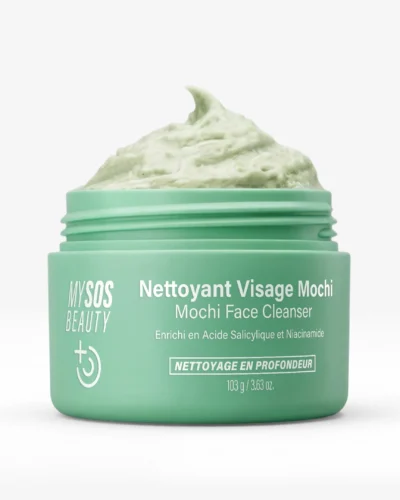
The Mochi Facial Cleanser is a good example of why product directions matter: apply a small amount to dry skin, massage while avoiding the eyes and mouth, rinse with lukewarm water, then pat dry with a clean towel. It is designed for combination to oily skin prone to blemishes and contains salicylic acid, an exfoliating active ingredient. If your skin feels tight, consider the cleanser as one possible factor rather than treating it as a solution to hard water.
Then examine the water
If your routine is already gentle, compare it with drinking water known to have lower hardness, based on an analysis or information from the supplier. A label that only says “low mineral content” does not necessarily mean the water has low hardness. Keep the temperature, cleanser and rinsing method the same, and repeat the comparison several times. You do not need to use bottled water.
Holidays are not a perfect comparison. The climate, makeup and daily habits may change too. At-home tests can offer clues, but they cannot diagnose the cause.
Filters, water softeners and face mists do different things
A filter is not automatically a water softener. The Penn State Extension guide to water softening describes ion exchange, which removes calcium and magnesium. A filter designed to remove other substances does not provide the same reduction. Check the technology, its stated performance for hardness and its maintenance requirements. “Limescale protection” does not guarantee a dermatological benefit.
The Anti-Blemish Mist is described by the manufacturer as refreshing and soothing. Apply it from approximately 30 cm away with your eyes closed: use 2 to 3 sprays and leave it on without wiping. It does not neutralise hard water and replaces neither rinsing nor moisturiser. Do not introduce a new mist while comparing the other factors.
FAQ
Should I stop using water to cleanse my face?
Not as a general rule. Begin by lowering the water temperature, avoiding rubbing and cutting out unnecessary cleansing. A rinse-off cleanser still needs to be rinsed off properly.
Can a cream compensate for hard water?
A moisturiser may make your skin feel more comfortable, but it does not soften water. If the discomfort continues, review your cleanser as well as your skin barrier.
When should I ask for advice?
Persistent tightness, burning, itching, patches or cracks are good reasons to seek professional advice. Read about the signs of sensitised skin, and do not keep testing products on irritated skin.
 -44%LIMITED OFFER

Comments (0)