
Your forehead is already shiny by lunchtime, but does the rest of your makeup still look even? Before reaching for more powder, take a moment to see what has actually changed. If your complexion still looks even, you probably do not need more foundation. For a simple makeup touch-up, remove the excess shine first, then correct only the areas where coverage has worn away.
These steps restore a comfortable finish without piling on more product. They do not treat oily skin.
A three-step lunchtime touch-up
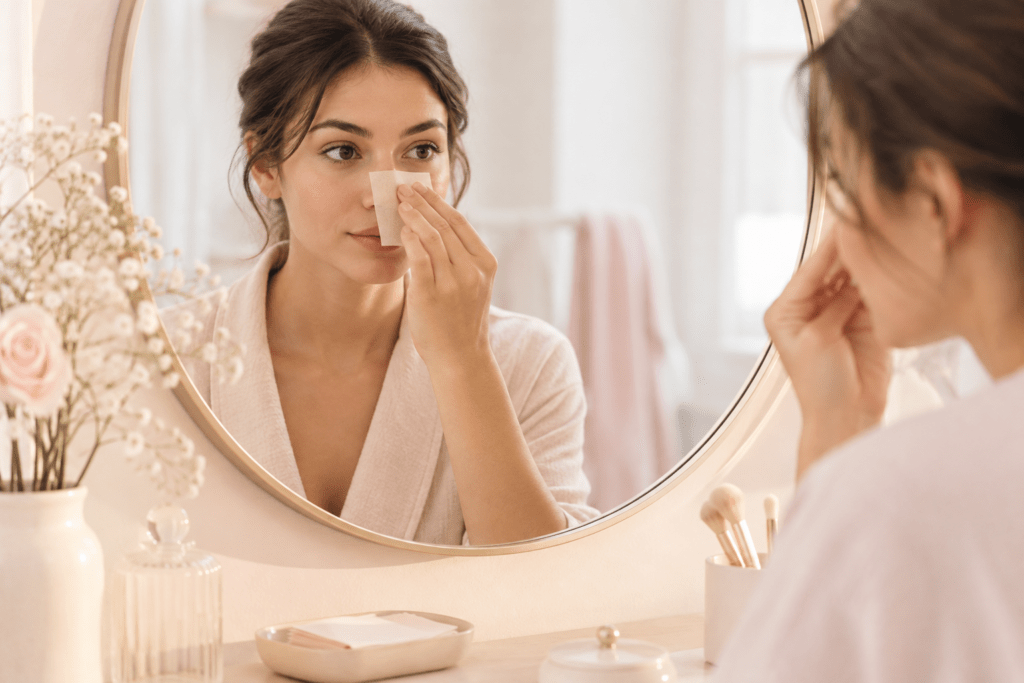
- Absorb excess shine without dragging: gently press blotting paper onto shiny areas, then lift it away.
- Replace coverage only where needed: tap a small amount of foundation onto areas where it has worn away.
- Set only if necessary: apply a light veil of powder to any areas that still look shiny after the first two steps.
If your complexion looks good after blotting, stop there. Sometimes the best touch-up is to add nothing.
Look before reaching for powder
Check your makeup in clear light. Shine and lost coverage call for different fixes: an evenly covered, shiny forehead is not the same as the side of your nose where foundation has shifted.
Take a look at your skin’s texture, too. If powder has already settled into lines or caught on flaky areas, avoid adding more there. And if you like the finish on your cheeks, leave them alone even if you touch up your nose.
To learn more about your skin beyond makeup, read our article on excess sebum. This guide focuses on making targeted adjustments to makeup that is already in place.
Absorb shine without rubbing
Blotting means pressing, not wiping. Place blotting paper on your forehead, nose or chin, apply light pressure, then lift it away without sliding it across your skin. Move to a clean section of the paper once the part you used has picked up oil.
If you do not have blotting paper, a clean, plain, lint-free tissue can work in a pinch. Use it the same way and avoid rubbing. The corner of a clean, dry makeup sponge can also help, although it may pick up more makeup. Start with a small area.
This technique removes some surface excess but does not change sebum production. If your foundation transfers, do not press harder. Check the coverage before continuing, since repeated passes may enlarge the area that needs correction.
Foundation and powder each have a role
Correct foundation only where it is missing
If foundation has worn away from a small area, use a minimal amount of your usual product. Place it in the centre of the area with a clean finger or a clean, slightly damp, well-wrung sponge.
Tap towards the edges to blend the correction into the makeup around it. There is no need to spread the product across your whole face. Check the result before taking more. A second small correction is easier to control than a thick layer that is difficult to remove.
Shine alone is not a reason to reapply foundation. If coverage needs restoring, do that before adding a final touch of powder.
Powder only the remaining shine
With a soft brush, pick up a small amount of powder and remove the excess before applying it. Press it on with light, small taps rather than firm sweeping motions. If you use a puff, distribute the powder across the applicator first, then gently press it onto the area concerned.
There is no universal amount to use. The powder should remain barely visible. Check the finish before adding more, especially around the nose and in folds. Areas that are already matte do not need to be repowdered automatically.
Keep your applicators clean and do not share them. If you have blemishes, our guide to makeup and acne offers additional advice on choosing products and applying these techniques.
Purifying pads: skincare, not a touch-up
The difference is simple: purifying pad = skincare on bare skin; blotting paper = touch-up over makeup. Do not run a purifying pad over your foundation to absorb shine. It may move your makeup and leave skincare on the surface under unsuitable conditions.
Keep purifying pads for your makeup-free routine and follow their instructions for use. If your skin becomes irritated or uncomfortable, stop touching up the area rather than carrying on.
In the evening, move from touch-up to cleansing
At the end of the day, remove your makeup with a suitable makeup remover. Our article on evening makeup removal explains this step in detail.
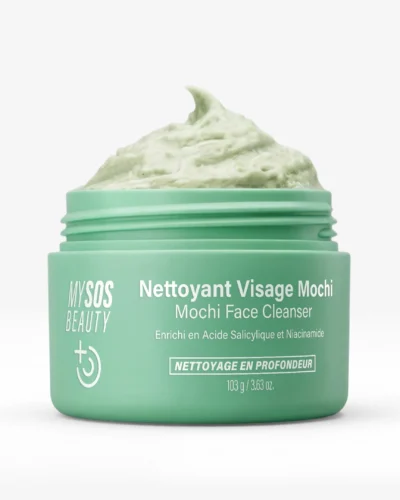
Mochi Facial Cleanser can then be included in a routine for combination to oily skin. The manufacturer states that it helps regulate sebum and that skin appears less shiny with regular use. It belongs in daily skincare, not in a lunchtime touch-up. It does not replace your makeup remover, so use it afterwards.
For cleansing, take a small amount of product and apply it to dry skin. Massage it over your face, avoiding the eyes and mouth, rinse with lukewarm water, then pat dry with a clean towel.
FAQ: your touch-up questions
What should I do if my complexion starts shining by 11 a.m.?
Blot first instead of automatically adding powder. If this happens often, take another look at the amount of skincare and makeup you apply in the morning. Do not remove hydration or try to strip your skin.
Loose or pressed powder for touch-ups?
Either can work. Pressed powder is convenient to carry, while loose powder requires more care with dosage. Choose a texture you know and apply it lightly.
Can I use a mist over makeup?
Only use one if it is intended for application over makeup. A mist does not replace absorbing sebum and may change your complexion’s finish. Avoid soaking your makeup.
Do I need an entirely matte face?
No. Correct only the areas that bother you. A touch-up also does not replace reapplying your sunscreen when necessary.
Sources
- American Academy of Dermatology, Face washing 101: gentle cleansing and patting dry.
- American Academy of Dermatology, Makeup and acne: light application, makeup removal and tool hygiene.
 -44%LIMITED OFFER


Comments (0)